

£12.99

Bob Bunyar (Signed Copy)
Status: In Stock, last copies before out of print
• Publication Date – 2025
• Format & Edition – Paperback
• Pagination – 88 Pages, 98 Illustrations
• Condition – New
• Genre – War Department


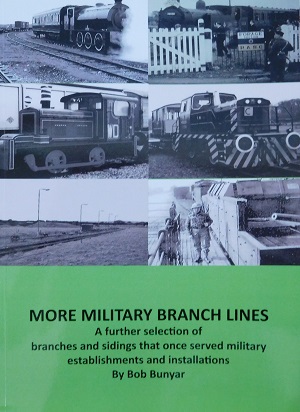
More Military Branch Lines by Bob Bunyar.
Having published a very successful and well received Military Branch Lines and Sidings in 2024, enough information and photographs had been collected to publish a Part 2 ‘More Military Branch Lines.’
This book first covers North Devon and Cornwall, looking at military sidings put in during WW II at Halwill Junction and Tower Hill together with war time connections between the SR and GWR lines. There is also information on rail-mounted guns that operated in the area, one of which was crewed by Polish officers! South Somerset is mentioned with loops and sidings being installed together with an ammunition depot at Alford. There was also an attack on Castle Carey Station on September 3, 1942, which saw fatalities and a GWR locomotive destroyed.
Army depots at Caerwent in South Wales and Ashchurch in Gloucestershire, each get their own chapters with the latter still being in existence and rail connected.
Moving northwards to Lancashire, a Royal Ordnance Factory built near Heapey Station, on the former Lancashire and Yorkshire Railway is covered, and a myth about strategic reserve steam locomotives stored there is dispelled. Back down south two RAF Fuel Depots and their sidings at Micheldever in Hampshire and Portfield in West Sussex are included in one chapter with a serious explosion being adverted at Micheldever while track removed from Portfield has assisted a Somerset based heritage railway.
The final Chapter is about a military base that is still with us today and uses rail. This is the Marchwood Military Railway and Port on Southampton Water.
Wartime photographs are of course difficult to obtain, due to restrictions, but every effort has been made to include as many photographs as possible and maps to go with the text. Finally, there is a Postscript, mentioning the Authors slight connection with military railways, his connection with the Swanage Railway in Dorset, and the link that has with the Army.